Showing posts with label sulab. Show all posts

Friday, June 16, 2017

Science Game Lab: tool for the unification of biomedical games with a purpose

Scripps team: Benjamin M. Good, Ginger Tsueng, Andrew I Su
Playmatics Team: Sarah Santini, Margaret Wallace, Nicholas Fortugno, John Szeder, Patrick Mooney, 
With helpful ideas from: Jerome Waldispuhl, Melanie Stegman

Abstract
Games with a purpose and other kinds of citizen science initiatives demonstrate great potential for advancing biomedical science and improving STEM education.  Articles documenting the success of projects such as Fold.it and Eyewire in high impact journals have raised wide interest in new applications of the distributed human intelligence that these systems have tapped into.  However, the path from a good idea to a successful citizen science game remains highly challenging.  Apart from the scientific difficulties of identifying suitable problems and appropriate human-powered solutions, the games still need to be created, need to be fun, and need to reach a large audience that remain engaged for the long-term.  Here, we describe Science Game Lab (SGL) (https://sciencegamelab.org), a platform for bootstrapping the production, facilitating the publication, and boosting both the fun and the value of the user experience for scientific games with a purpose.  

Introduction
Ever since the Fold.it project famously demonstrated that teams of human game players could often outperform supercomputers at the challenging problem of 3d protein structure prediction, so-called ‘games with a purpose’ have seen increasing attention from the biomedical research community.  A few other games in this genre include: Phylo for multiple sequence alignment, EteRNA for RNA structure design, Eyewire for mapping neural connectivity, The Cure for breast cancer prognosis prediction, Dizeez for gene annotation, and MalariaSpot for image analysis.  Apart from tapping into human intelligence at scale, these efforts have also produced valuable educational opportunities.  Many of these games are now used to introduce their underlying concepts in classroom settings where games in all forms are increasingly working their way into curriculums.  Concomitant with the rise of these ‘serious games’, citizen science efforts such as the Zooniverse and Mark2Cure have sought similar aims but have packaged their work as volunteer tasks, analogous to unpaid crowdsourcing tasks, rather than as elements of games.  

Many of these initiatives have succeeded in independently addressing challenging technical problems through human computation, improving science education, and generally raising scientific awareness.  However, with so much interest from the scientific community and a booming ecosystem of game developers, there are actually relatively few of these games in operation now.  Recognizing the opportunity, various groups have attempted to push the area forward through new funding opportunities and through various ‘game jams’ such as the one that produced the game ‘genes in space’ for use in analyzing microarray data in cancer.  Here, we take a different approach towards expanding the ecosystem of games with a scientific purpose.  Rather than attempting to seed the genesis of specific new game-changing games, we hope to lower the barrier to entry for new games and related citizen science tasks to generally promote the development of the entire field.  With this high-level aim in mind, we developed Science Game Lab (SGL) to make it easier for developers to create successful scientific games or game-like learning and volunteer experiences.  Specifically, SGL is intended to address the challenges of recruiting players and volunteers, keeping them engaged for the long term, and reducing the development costs associated with creating a scientific gaming experience.

The Science Game Lab Web application
SGL is a unique, open-source portal supporting the integration of games and volunteer experiences meant to advance science and science education (https://sciencegamelab.org).  Unlike other related sites that act more like volunteer management and/or project directory services, such as SciStarter and Science Game Center, SGL is not simply a listing of related websites.  Rather, it is an attempt to create a user experience that takes place directly within the SGL context yet still incorporates content from third parties.  The system is largely inspired by game industry portals such as Kongregate that enable developers to incorporate their games directly into a unified metagame experience .

Players can use the portal to find and play games with their achievements within the games tracked on site-wide high score lists and achievement boards (Figure 1).  Players can earn the SGL points that drive these leaderboards for actions taken in different games.  In this way, SGL provides developers with access to a metagame that can be used to encourage players in addition to the incentives offered within individual games (Figure 2).  This metagame can also be used by the system administrators to help direct the player community’s attention to particular games or particular tasks within games.  For example, actions taken on new games might earn more points than actions taken on more established games as a way to ‘spread the wealth’ generated by successful games.    
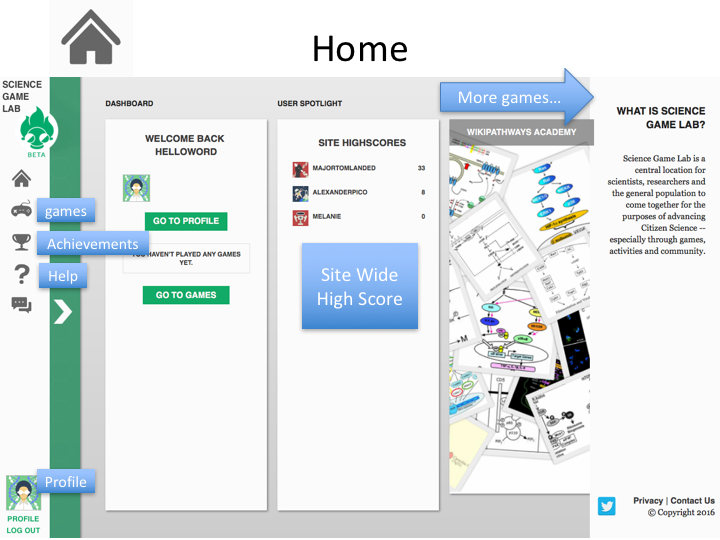
Figure 1.  SGL home page demonstrating site-wide high score list, game listing, and links to achievements, help, and user profile information.
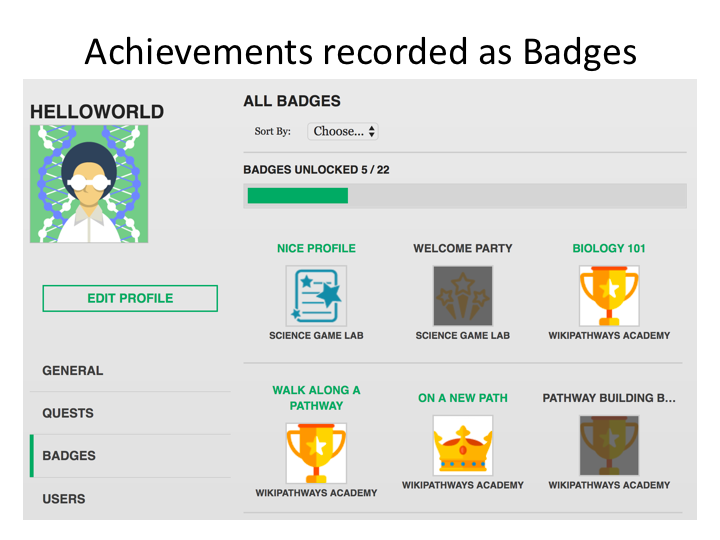
Figure 2.  Badges displayed on user’s profile page.  Available badges not yet achieved are greyed out.
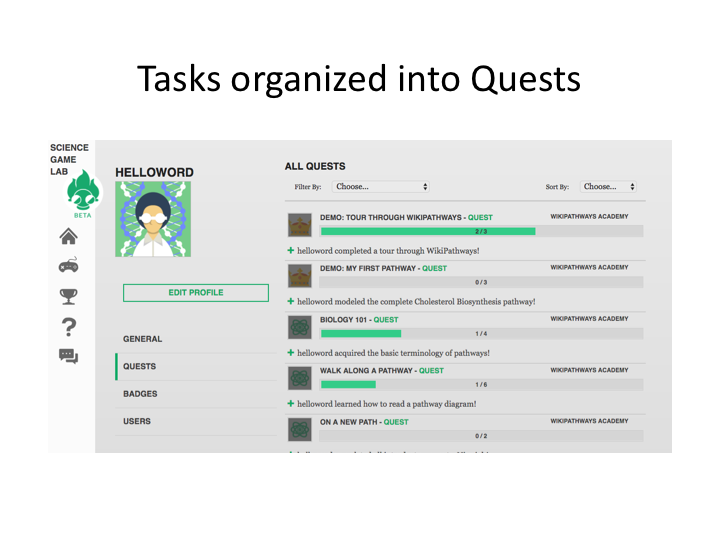
 Developers interact with SGL by incorporating a small javascript library into their application and using the SGL ‘developer dashboard’ to pair up events in their game with points, badges and quests managed by the SGL server.  At this time, SGL only supports games that operate online as Web applications.  The games are hosted by the developers and rendered in the SGL context within an iframe.  The SGL iframe provides a ‘heads up display’ that provides real time feedback to game players with respect to events sent back to the SGL server such as earning points, gathering badges, or progressing through the stages of a quest (Figure 3).  This display provides developers with the ability to add game mechanics to sites that are not overtly games.  For example, Wikipathways incorporated a pathway editing tutorial into SGL, using the heads up display to reward users with SGL points and badges for completing various stages of the tutorial.   The tutorial also took advantage of the SGL quest-building tool (Figure 4).  Games are submitted by developers for approval by SGL administrators.  Once approved, the games appear in the public view and can be accessed by any player.  
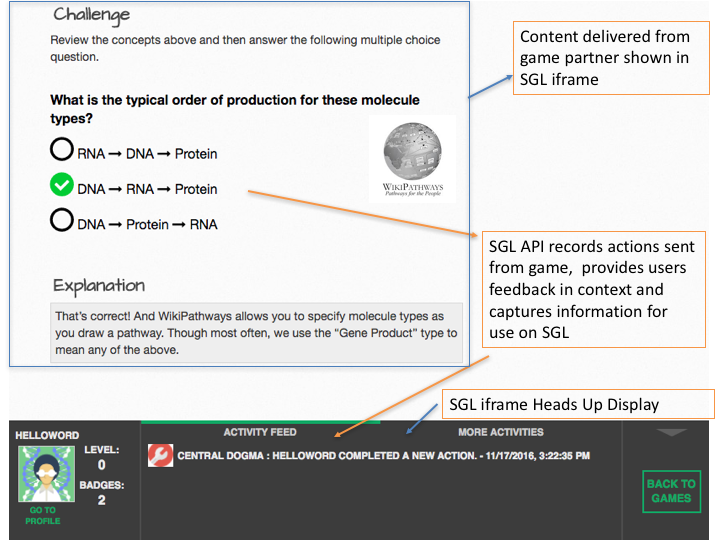
Figure 3.  The heads up display provided by the SGL iframe.  Shows events captured by the API and provides users with immediate feedback.   


Figure 4.  Tasks in SGL can be grouped into quests.  The figure shows a particular user’s progress through various quests available within the system.


Discussion
If a critical initial mass of effective games can be integrated, SGL could strongly benefit new developers by providing immediate access to a large player population.  Site-level status, identity and community features can help with the even greater challenge of long-term player engagement, a noted problem in the field.  Within the context of science-related gaming, such status icons might eventually be used as practically useful, real-world marks of achievement inline with the notion of ‘Open Badges.  As demonstrated by the Wikipathways tutorial application, SGL can be used to replace the need for developers to host their own login systems, user tracking databases, and reward systems - all of which can be accomplished using the SGL developer tools. Citizen scientists are not homogenous in their motivations. Designing to be inclusive of gamers and non-gamers can be challenging. By offering an alternative means of experiencing a web-based citizen science application, SGL allows developers to cater to both their gaming and non-gaming contributor audience. Together, these features unite to raise the overall potential for growth within the world of citizen science and scientific gaming.  

Future directions
SGL is currently functional, but so far has attracted only a small number of developers willing to integrate their content into the portal.  Future work would need to address the challenge of raising the perceived value of integration with the site while lowering the perceived difficulty.  Looking forward, key challenges for the future of SGL include better support for:
  • games meant for mobile devices
  • development of quests that span multiple games
  • teachers to build SGL-focused lesson plans and track student progress
  • creating new ‘SGL-native’ games
  • integration with external authentication systems

None of these are insurmountable challenges, but they all require significant continued investment in software development.  As an open source project, we encourage contributions from anyone that shares in our vision of spreading and doing science through the grand unifying principle of fun.

Building communities of knowledge with Wikidata

As the Wikimedia Movement works to define its strategy for the next fifteen years, it is worthwhile to consider how its recent product Wikidata may fit into that strategy.  As its homepage states,

Wikidata is a free and open knowledge base that can be read and edited by both humans and machines.” https://www.wikidata.org/

Wikidata is a particular kind of database designed to capture statements about items in the world with references that support those statements.  Because Wikidata is a database, its contents are meant to be viewed in the context of software that retrieve the data through queries and then renders the data to meet the needs of a user in a certain context.  The same data can thus be viewed on Wikidata-specific pages such as https://www.wikidata.org/wiki/Q13561329 and in the infoboxes of Wikipedia articles such as https://en.wikipedia.org/wiki/Reelin.  Importantly, Wikidata content can also be used in applications outside of the Wikimedia family such as http://wikigenomes.org.   

Examples of Wikidata use now include:

The molecular biology community (and in particular the Gene Wiki group) has embraced Wikidata as a global platform for knowledge integration and distribution.  To help envision how Wikidata may fit into the strategic vision of the WMF movement, it is worth taking a look at how and why this particular community is using Wikidata.  

History of the Gene Wiki initiative
The sequencing of the human genome at the beginning of this century and the consequent rush of data and new technology for producing even more data fundamentally changed how research in biology is conducted.  Before the year 2000, research typically proceeded with a single gene focus.  A typical PhD thesis would entail the analysis of the genetics or function of one gene or protein at a time.  A few years after the first genome however, it became possible to measure the activity of ten’s of thousands of genes at once resulting in an omnipresent problem of generating interpretations of experimental results containing hundreds of genes.  While a scientist may come to grasp the literature surrounding a single gene quite well, it is not possible to know everything there is to know about all 20,000+ genes in the genome - particularly when this knowledge is expanding on a minute by minute basis.  As a consequence, there arose a need to produce summaries of what was known about each gene so that researchers could quickly grasp its nature and easily find links to more detailed references as needed.  By 2008, many different research groups published wikis attempting to allow the scientific community to generate the required articles, e.g. WikiProteins, WikiGenes, and the Gene Wiki.  The Gene Wiki project was unique among this group as it anchored itself directly to Wikipedia and, likely as a result of that decision, has enjoyed long term success.  This initiative works within the English Wikipedia community to encourage and support the collection of articles about human genes.  Its main contributions are the infobox seen on the right hand side of of these articles and software for generating new article stubs using that template.  

Wikidata and the Gene Wiki project

For the past several years, the Gene Wiki core team (funded by an NIH grant) has focused primarily on seeding Wikidata with biomedical knowledge.  In comparison to managing data via direct inclusion and parsing of infobox templates as before, this makes the data much easier to maintain automatically and, importantly, opens it up for use by other applications.  As a result, Wikipedia isn’t the only application that can use this structured information.   One of the first products of that process was a new module (Infobox_gene) that draws all the needed data to render the gene infobox dynamically from Wikidata, greatly reducing the technical challenge of keeping the data presented there in sync with primary sources.  

In addition to the relatively simple collection of gene identifiers and links off to key public databases that are presented in the infoboxes, Wikidata now has an extensive and growing network of knowledge linking genes to proteins, proteins to drugs, drugs to diseases, diseases to pathogens, pathogens to places, places to events, events to people, and so on and so on.  This unique, open, referenced, knowledge graph may eventually become the closest thing to ‘the sum of all human knowledge’.  Capturing knowledge in this structured form makes it possible to use it in all kinds of applications, each with their own community-specific user experiences.  As a case in point, the Gene Wiki group created Wikigenomes based primarily on data loaded into Wikidata.  This was followed quickly by Chlambase, an application specifically focused on distributing and collecting knowledge about different Chlamydia genomes.  These applications provide domain-specific user interface components such as genome browsers that are needed to present the relevant information effectively and thereby attract the attention of specialist users.  These users, in turn, have the opportunity to contribute their knowledge back to the broader community through contributions to Wikidata that can be mediated by the same software.  

Wikidata and the world
The molecular biology research community, as represented by the Gene Wiki project, are early adopters of Wikidata as a community platform for the collaborative curation and distribution of structured knowledge, but they are not alone.  The same fundamental patterns are already being applied by other communities, e.g. those interested in digital preservation and open bibliography.  In each case, we see communities working to transition from the current dominant paradigm of private knowledge management towards the knowledge commons approach made possible by wikidata.  This is not unlike the transition from the world of the Encyclopedia Britannica to the world of Wikipedia.  The only important difference is that the knowledge in question is structured in a way that makes it easier to reuse in different ways and in different applications.  


Wikidata provides a mechanism for massively increasing the global good generated by the Wikimedia Foundation’s work by capturing knowledge in a form that can be agilely used to empower all manner of software with the sum of human knowledge.  

Friday, October 23, 2015

Introducing Knowledge.Bio

I just prepared the following poster abstract for the upcoming Big Data 2 Knowledge all-hands meeting at NIH.  Please play with the tool it describes and let us know what you think (it is a work in progress!).  Also, if you have a chance, please stop by the poster and say hello!

Knowledge.Bio: an Interactive Tool for Literature-based Discovery 
Personal knowledge graph showing literature-derived connections
 between Sepiapterin Reductase (SPR) and 5-Hydroxytryptophan
(a treatment for patients with deleterious mutations in SPR.
Benjamin M. Good, Ph.D.1; Richard M. Bruskiewich, Ph.D. 2; Kenneth C. Huellas-Bruskiewicz2; Farzin Ahmed2; Andrew I. Su, Ph.D.1
1 The Scripps Research Institute, La Jolla, CA, USA. 2 STAR Informatics / Delphinai Corporation, Port Moody, BC, Canada

PubMed now indexes roughly 25 million articles and is growing by more than a million per year.  The scale of this “Big Knowledge” repository renders traditional, article-based modes of user interaction unsatisfactory, demanding new interfaces for integrating and summarizing widely distributed knowledge.  Natural language processing (NLP) techniques coupled with rich user interfaces can help meet this demand, providing end-users with enhanced views into public knowledge, stimulating their ability to form new hypotheses.

Knowledge.Bio provides a Web interface for exploring the results from text-mining PubMed.  It works with subject, predicate, object assertions (triples) extracted from individual abstracts and with predicted statistical associations between pairs of concepts.  While agnostic to the NLP technology employed, the current implementation is loaded with triples from the SemRep-generated SemmedDB database and putative gene-disease pairs obtained using Leiden University Medical Center’s ‘Implicitome’ technology.  

Users of Knowledge.Bio begin by identifying a concept of interest using text search.  Once a concept is identified, associated triples and concept-pairs are displayed in tables.  These tables have text-based and semantic filters to help refine the list of triples to relations of interest.  The user then selects relations for insertion into a personal knowledge graph implemented using cytoscape.js.  The graph is used as a note-taking or ‘mind-mapping’ structure that can be saved offline and then later reloaded into the application.  Clicking on edges within a graph or on the ‘evidence’ element of a triple displays the abstracts where that relation was detected, thus allowing the user to judge the veracity of the statement and to read the underlying articles.

Knowledge.Bio is a free, open-source application that can provide, deep, personal, concise, shareable views into the “Big Knowledge” scattered across the biomedical literature.  It is available at http://knowledge.bio, with source code at https://bitbucket.org/starinformatics/gbk


Wednesday, October 21, 2015

Poof it works - using wikidata to build Wikipedia articles about genes

Infobox for ARF6,
rendered entirely from
content Wikidata
The Gene Wiki team has been hard at work filling wikidata with useful content about genes, diseases, and drugs using the new and improved ProteinBoxBot.  Now, we are starting to see the fruits of this labor in the context of Wikipedia.

The Gene Wiki project has programmatically created and maintained the infoboxes to the right of all the articles in Wikipedia about human genes since about 2008 [Huss 2008].  This process has entailed the construction of a unique template containing all of the relevant data for each gene.  For example, here is the code for the template for the ARF6 gene.  As Wikipedia previously had no database, that is where the data was stored.  Altering that content programmatically involves parsing that template as a string.  Its ugly (sorry Jon) and there are more than 11,000 of these templates to maintain (one per gene in Wikipedia).

Now, the same data can be represented in Wikidata, a queriable, open graph of claims about the world backed by references and specified by qualifiers [Vrandečić 2014].  Now that the content needed to render the infobox is all there, we can convert 11,000+ complex templates that require string parsing to maintain to a single, re-usable template for all of them.

The first cut at the new template is {{infobox gene}}.  If you put that on any article about a human gene, you ought to get the complete infobox for the article without any further ado.  Poof!  You can view it in action on this revision for ARF6.  We haven't rolled out the new template across all the articles yet, but hope to see that happen in the coming months.  Remaining issues include: better error-handling in the template code, better ways to give users the ability to edit the associated data in wikidata, and updates to all of the code that produces gene wiki articles.  If you want to help, chime in on the module:wikidata thread.


Tuesday, July 7, 2015

Recruiting NLP-crowdsourcing-semantic-web postdoc or staff scientist

Our laboratory at the The Scripps Research Institute in beautiful San Diego, California is recruiting a talented individual to help us use crowdsourcing to push the boundaries of biomedical information extraction and its applications.   We are looking for someone with experience in natural language processing (statistical or linguistic), machine learning, and knowledge representation.  This person would work to integrate efforts across several related projects.  
Ongoing and nascent projects include:
Sound like fun? Ready to jump in?
Contact Andrew Su and or Benjamin Good for more information.

p.s. We have other openings in related areas!


Wednesday, March 4, 2015

crowdsourcing machine learning NLP challenge

There is a TopCoder contest running right now that involves machine learning, crowdsourced data, and natural language processing.  There is $41,000 up for grabs!  It will be distributed in many smaller prizes so there are plenty of opportunities to win something.

You need to register by tomorrow (March 4, 2015) to participate!  

More details here:
https://www.topcoder.com/blog/registration-for-banner-is-now-open/


Friday, February 20, 2015

Building a Garden of Biological Knowledge

March 13, 2013 I wrote up an idea in my notebook that I called 'Pubmed Daily'.  The concept was to build a system that would leverage large-scale crowdsourcing/citizen science and machine learning to produce a high-quality, structured representation of the knowledge in every abstract in PubMed on the same day that the abstract appeared online.  Nearly two years later, based mainly on the labor of outreach coordinator Ginger Tsueng, group leader Andrew Su, and programmer Max Nanis, the idea is just starting to bear fruit (albeit small, perhaps grape size fruits..) .  As the bits and pieces start to come together, I thought it would be worthwhile to share the high-level vision as it exists now.

A Garden of Biological Knowledge


We want to build an information management system (or systems) that supports the work of three key groups of people: bioinformaticians such as Andrew, biologists such as Hudson Freeze, and patient advocates such as the parents and friends of Bertrand Might, a child with a rare genetic disorder related the NGLY1 gene.  The over-arching goal is to produce more rapid biomedical advances based on more effective use of existing knowledge in the processes of of hypothesis generation and high-throughput data analysis.

The thinking goes like this.  Given a high-quality, structured knowledge base such as the Gene Ontology (GO), Andrew and people like him can make many different kinds of discovery and analytical tools that can help scientists such as Hudson work more effectively (and they do, there are thousands of tools that use the GO).  The problem is that the generation of knowledge bases like the GO is a long, slow, expensive process that in no way keeps pace with the advance of knowledge as represented in the literature.  Information extraction systems like DeepDive and SemRep can theoretically go a long way to addressing this problem.  However, humans remain more effective (though obviously dramatically slower) readers.

Can we use computers to seed a garden of knowledge that can be tended and grown by citizen scientists?

Given a compelling argument, clear instructions, and an effective user interface, we think that large numbers of people from the general public could be assembled to work on improving the results of a biomedical information extraction system.  We, and other groups, have been experimenting with various related tasks using the Amazon Mechanical Turk and are now confident that "the crowd" can, in aggregate, do text-processing work at or above expert level.  A recent conversation with a leader of the Zooniverse project, a collection of online citizen science projects with more than a million people contributing, leads us to believe that it would be possible to attract tens to hundreds of thousands of people to participate in an effort like this.  Recently, we took the first steps towards testing that assumption via a short but successful test run of the Mark2Cure Web application.

Can we build a new generation of tools for working with structured biomedical knowledge at massive scales and use these to empower the rising community of citizen scientists?

Aside from the knowledge bases themselves, we are also interested in building better tools for navigating this information and in putting them into the hands of both professionals like Hudson, and the many very intelligent, highly motivated people from other domains that might also be able to find something important given the chance (e.g. Mathew Might).

Can a large volunteer work force help teach computers to read?

By engaging volunteers at scale, we hope to provide the developers of information extraction algorithms with the data they need to raise their approaches to human levels of quality.

We have a long, challenging road ahead on this project but the path ahead is starting to take shape and the future looks bright!


Tuesday, November 11, 2014

Hackathon recap: Network of Biothings in San Diego

This past weekend, Nov. 7-9, the Neuroscience Information Framework, the Su Lab, NDex, The International Society for Biocuration and the San Diego Center for Systems Biology hosted the second Network of Biothings Hackathon.  The event took place at Atkinson Hall (Calit2) on the UC San Diego campus.  For the record, and to enhance what can already be seen in the Twitter story of this event, here is what went down.

Friday evening about 30 people arrived at Atkinson hall where they:
  1. consumed Indian food and American beverages, 
  2. met each other and talked over project ideas, 
  3. each decided on a project to work on for the weekend
Saturday the group:
  1. ate bagels for breakfast, sandwiches and leftover Indian food for lunch, and pizza for dinner
  2. hacked furiously to develop 8 distinct team projects
Sunday morning, we came together for more bagels, some last minute hacking and rapid presentation formation.  At 10:30am we got started with 8, 10 minute project presentations.  Here is a very brief list of the projects with links out to all of the code that was developed.  (More details are available on the ideas page.)
  1. BioPolymer: A set of embeddable web components to display and edit bio data. Initially data from MyGene & MyVariant. Team: Mark Fortner, Keiichiro Ono
  2. SameSame: a dynamic tool for finding and visualizing the degree of similarity between any set of biomedical concepts.  Team: Benjamin Good, Maulik Kamdar, Alan Higgins, Alex Williams
  3. CIViC - Clinical Interpretation of Variants in Cancer:  Crowdsourcing and web interface for curation of clinically actionable evidence in cancer.  Team: Obi Griffith, Adam Coffman, Martin Jones, Karthik G, Jon Cristensen, Julianne Schneider
  4. Citizen Science: An app to enable people to extract structured ‘facts’ (subject predicate object triples) from unstructured text.  Here is the project presentation.  Team: Richard Good, Hannes Niedner, Andrew Su
  5. SBiDer: Synthetic Biocircuit Developer: A web-app to search a database of operons [functional biochemical pathways] to use them in new and novel ways [to make synthetic organisms such as the ones used to make this Malaria treatment].  Team Justin Huang, Kwat Yeerna, Fernando Contreras, Joaquin Reyna, Jenhan Tao
  6. NDex: The NDEx project provides a public website where scientists and organizations can share, store, manipulate, and publish biological network knowledge. Team Dexter Pratt
  7. fiSSEA: A framework that integrates MyGene.info and MyVariant.info to retrieve functional prediction annotations (or any type of annotation) for knowledge discovery, specifically implement CADD scores for “functional impact SNP Set Enrichment Analysis". Team: Adam Mark, Erick Scott, Chunlei Wu
  8. MyGene.Info Taxonomy Query: Added detailed taxonomy information to mygene.info. Allows queries based on taxonomy ID and advanced queries based on hierarchies of taxonomic nodes.  Team: Greg Stupp, Chunlei Wu
Hackathon Trophy


And the winners were...
#1 Citizen Science
#2 SBiDer
!


There were a lot of very exciting things about this event.  In addition to a strong core of academics from multiple universities, we also had local app and algorithm developers from industry.  While the US west coast lean was powerful, we did have representatives from St. Louis and one that came all the way from Canada.  We also had a very strong undergraduate team (taking second place!).  All of the projects clearly made real progress over the weekend with some excellent cross-pollination of code and ideas.
And the coolest thing about this event??
My Dad was on the winning team :).. Go Dad!
Special thanks to Martin Jones for running around with me picking up bagels, pizza, drinks, and snacks for everyone and to Jeffrey Grethe for keeping everything running smoothly at the event, pushing around tables, helping clean up after the hackers, and calmly handling everything that needed to be done.  

Tuesday, November 4, 2014

What is a hackathon?

As an organizer of the upcoming Network of Biothings Hackathon at UC San Diego, I've been asked by a number of people what a hackathon is exactly.  I'm repurposing one of those responses here (original posted on the San Diego iOS developers meetup group).

The main idea is that a variety of different people come together to meet each other and make something together - almost always something open source. In the case of our hackathon, the purpose is specifically to engender new collaborations. For the academics these could translate into new research programs and new collaborative grant proposals. For industry folks, these could turn into new products.  Ideally, a hackathon can bring together the elements of a great new team. For example, I'm a back-end database guy with an understanding of bioinformatics. I'd love to find a front-end web or app developer to help make my data and algorithms useful to the rest of the world.

Here are a few questions I've fielded:

  • why do developers pay to build apps for somebody else? 
The money goes to pay for food, drinks, facilities fees, and to a small extent the prize. Developers don't pay to develop for someone else, they pay to meet other people and to eat.. No one is under any obligation to give their code to anyone else. You would be welcome to come by and work on your own project. In fact, we are actively trying to get more project ideas posted for our hackathon. (Note that the fee we are asking for is only $40 and many hackathons with larger sponsors are free).
  • why do developers put their time to do work for free?
The main point here is team formation. If you have a great app, this is also a way to advertise it - especially if it wins a prize.
  • do the teams who paid to participate build apps and one is chosen as winner? 
Yes, this is the basic idea.
  • are the rest thrown away? 
Nothing is thrown away. The participants maintain ownership of all code that is written. (Though open source is very strongly encouraged...)
  • Am I too young/old to participate?
Nope!  All are welcome.

In conclusion, hackathons are fun, social events for people that like to build new things, meet new people, and perhaps the change the world.  Sign up for ours and find out for yourself!

Monday, October 6, 2014

Network of Biothings Hackathon at UC San Diego

Can you code?

Are you interested in the intersection of computer science and biology (bioinformatics) ?

Do you want to meet interesting people?

Are you excited about building new pieces of software that could change the face science and medicine? 

Do you want to win a cash prize for your open source code?

Then its clearly time to:
  • Location:  UC San Diego on the 5th floor of the CALIT2 building
  • Sign up:  sign up 
  • Schedule:
  • Friday, November 7
    • 6-10pm : Welcome social / project team formation
  • Saturday, November 8
    • 9am-? : Hacking !
  • Sunday, November, 9 
    • 9am-10:30: Final hacking / presentation preparation
    • 10:30:11:30 Pitches and Demos
    • 11:45: Prize announcements

Click here for additional details.

Wednesday, August 13, 2014

Network of BioThings: Hackathon 2 San Diego (when?)

The Network of Biothings, first announced in December of 2013, is being imagined by a loose, self-organizing consortium of people who share the vision of uniting and linking the world's biological and medical knowledge.  In support of this vision, The Su Laboratory, with partners at UCSD, is gearing up to host the second Network of Biothings Hackathon.  The first hackathon was an exciting and very educational event that sparked some useful projects such as http://myvariant.info/.  We are hoping to build on that momentum with an even more successful second event.

If you would like to participate in Hackathon 2, you can begin by helping us solve the most challenging problem of all: picking dates for a hackathon!  Please fill in dates that you would be available to come hack with us in San Diego at this poll:

http://doodle.com/z2irpfma6apyavpk

Why should you bother?
When faced with challenges such as selecting the best treatment for a patient or coming up with the next candidate drug target for a rare disease, we are now presented with an unbelievable wealth of data including: full genome sequencing, mRNA expression, miRNA expression, methylation, metabolomics, proteomics, clinical, imaging, and on and on.  In order for this new data to be useful, we depend on networks of knowledge.  For example, we may be able to detect that a particular gene is acting unusually in a patient, but we need to know something about that gene's biological function before we can use the new information to inform a clinical decision.  Many many valuable databases continue to arise that help address this fundamental challenge, but there is a clear consensus that most knowledge - especially the vast amount that is shared through the literature - is not accessible in any coherent form.  With your help, that coherent form - whatever it ends up looking like - could arise from the Network of Biothings.